


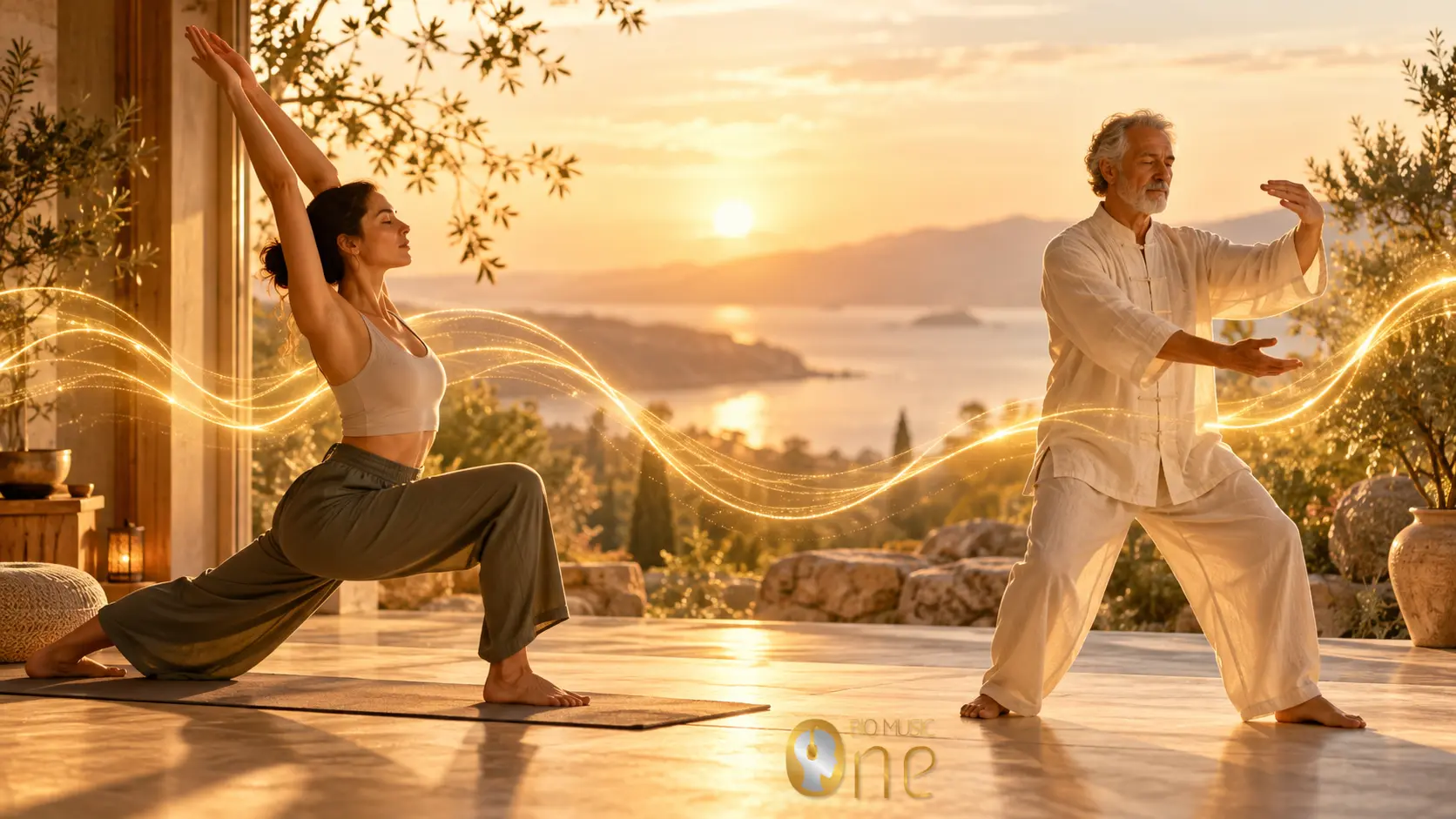
Yoga and Martial Arts: Bringing Greater Awareness to Movement with Bio Music One
Become more attuned to your body, rediscover fluidity in movement and enrich your yoga, tai chi, qigong or other movement practice through an original musical approach.
BMO can complement an established practice while also inviting you to explore freer, more intuitive movement guided by how your body feels.
What if you let your body guide you more?
Yoga, tai chi, qigong and martial arts invite us to develop a more conscious relationship with our bodies. Through postures, movement, breathing and attention, these disciplines offer many opportunities to cultivate inner balance.
Yet as we practise, we may sometimes focus more on performing a movement correctly than on what we are actually feeling as we do it.
We try to reproduce a posture, complete a sequence or improve our technique, without always noticing the information our bodies are giving us.
What if we made more room for those sensations?
Recognising our abilities and limits, naturally adjusting a movement, becoming more aware of our breathing, or simply rediscovering the pleasure of moving freely: all these can enrich our practice.
Bio Music One: Musical Support for More Mindful Practice
Bio Music One offers an original musical approach that you can incorporate into your yoga, tai chi, qigong or martial arts sessions to explore a more attentive, intuitive relationship with your body.
Several teachers and practitioners report greater fluidity in their movements, a heightened awareness of bodily sensations and a stronger sense of inner presence when practising with BMO.
1. Supporting Your Established Practice with BMO
Whether you practise alone or in a class, you can bring Bio Music One into your discipline without changing the exercises or sequences you already know.
Played audibly in the background, BMO compositions accompany your movements and breathing, providing a musical presence throughout your session. In Inaudible & Continuous mode, you can maintain your usual sound environment while BMO continues playing.
Some practitioners describe a quieter mind, greater concentration or a clearer awareness of their movements and how they flow together.
2. Intuitive Yoga with BMO
Beyond supporting an established practice, Bio Music One also invites you to explore a freer, more intuitive approach to yoga.
Rather than always following a predefined sequence, you give more space to movements that arise naturally, while remaining attentive to your body’s sensations, needs and capabilities.
The aim is not to abandon the knowledge and techniques you have acquired, but to combine them with closer inner listening, allowing movement to become gradually more fluid, mindful and respectful of your individual abilities.
During a yoga session accompanied by Bio Music One at the Culture Yoga centre in Paris, teacher Morgane Legoff described letting the movements flow almost naturally, offering her students fewer verbal instructions than usual. Her experience captures the spirit of intuitive yoga with BMO: rediscovering a more fluid relationship with the body, where technique remains a resource but inner awareness takes centre stage.
They Share Their Experiences
“The movements came to me of their own accord, following one another naturally without my having to think about them. I didn’t feel like talking; I wanted to follow my body, which had taken the lead.”
“I use Bio Music One during my yoga practice to improve my performance and become more attuned to my body.”
“I feel that Bio Music One helps me become aware of the energy flowing through movement. It gives me greater concentration, an almost complete disappearance of fatigue and heightened awareness of movement.”
“Practising and teaching physical yoga with Bio Music One is a gift. I settle into calm more quickly; the present moment arrives with all its gentleness, and everything flows.”
“And then the magic happens: I simply notice a mood, an atmosphere, a release, a letting go… a disconnecting in order to reconnect with something else.”
These testimonials reflect the personal experiences of teachers and practitioners. Feelings and experiences may vary from person to person and from session to session.
What If You Explored a Different Way of Experiencing Your Practice?
Why not bring Bio Music One into your next yoga, tai chi or qigong session and discover what this musical experience might add to your practice?
Choose an album whose excerpts appeal to you, then let it accompany your usual practice as background music or in Inaudible & Continuous mode, whichever you prefer.
As you move, pay particular attention to your sensations. How do your movements feel? Your breathing? Your balance? Your ability to relax or remain present in each gesture?
If you practise yoga and would like to explore a more intuitive approach, you can also set aside some time for free, simple and comfortable movements, guided by how you feel rather than by a prescribed sequence.
Over the course of your sessions, notice whether your relationship with movement changes. Do you feel freer, more fluid, more attuned to your body?
To begin exploring BMO, we invite you to listen to free excerpts from the Bio Music One albums, available on our website and in our app. The album Kinema 1 was used by several of the teachers and practitioners whose experiences are featured here.
Bio Music One offers a musical wellbeing experience. The accounts presented do not demonstrate improvements in physical performance or the prevention of injuries. Always adapt movements to your abilities and to your teacher’s guidance.
Did You Know?
Bio Music One has also been explored in the teaching of yoga, tai chi and qigong.
Several teachers report a keener awareness of movement, greater fluidity in their sequences or students who seem more receptive during sessions.
Their accounts particularly highlight the value of a practice that makes more room for felt experience, rather than focusing solely on the technical reproduction of postures.
Personal observations collected by BMO from teachers and practitioners. These are not the results of a comparative study.